


Views: 0 Author: Site Editor Publish Time: 2026-08-13 Origin: Site


Rejected backlit displays represent a massive drain on material resources and labor hours for print service providers. The frustration often stems from print defects that remain entirely hidden under standard room lighting, only to reveal themselves the moment the graphic is installed and illuminated. Among these defects, mottling—characterized by uneven ink distribution, cloudiness, or coalescence—is the most persistent and damaging. Backlighting acts as a magnifying glass, exposing microscopic inconsistencies in ink absorption across the media surface.
Coating uniformity serves as the primary defense against these costly failures. When producing high-end light box graphics, the interaction between the ink droplet and the receiving layer dictates the final visual quality. This guide provides a technical evaluation framework to help print professionals assess coating technologies, match ink chemistries, and select the appropriate media. By understanding the mechanics of ink absorption and substrate engineering, operators can eliminate mottling and deliver flawless illuminated displays.
Coating Architecture Determines Absorption: A consistent, micro-porous ink-receiving layer is non-negotiable for preventing ink pooling and back-trap mottle.
Illumination Magnifies Defects: Even minor variations in coating thickness or density will translate into visible dark spots or color shifts under LED backlighting.
Ink-to-Coating Compatibility is Critical: Formulations must match; using eco-solvent inks on mismatched coatings leads to improper drying and coalescence.
Environmental and Profile Controls: High-quality film must be paired with precise ICC profiling, strict ink limits, and controlled print-room humidity to maximize uniformity.
In the context of illuminated displays, mottling manifests as distinct visual flaws that ruin the intended graphic impact. These defects typically appear as density variations, gloss banding, or patchy solid areas. A successful print on anti glare light box media must exhibit perfectly smooth gradients and solid colors that maintain uniform opacity when backlit. Any deviation from this standard compromises the brand integrity of the advertisement or display. Print operators on the shop floor know that a graphic looking perfect on the finishing table can look like a disaster once mounted in a light box. The success criteria demand zero visible density shifts when subjected to 5000K LED backlighting.
Understanding the physical mechanisms behind print defects is essential for troubleshooting. Coalescence occurs when wet ink droplets merge on the surface of the media before they have a chance to dry or absorb. This creates a puddle-like, cloudy appearance, often resulting from an oversaturated coating or insufficient heating during the print process. The ink fails to hold its intended dot shape, leading to a loss of detail and uneven color distribution. When you look closely at a coalesced print, the edges of solid color blocks look jagged, and gradients appear stepped rather than smooth.
Back-trap mottle involves a different physical mechanism. This defect happens when ink from a previously printed pass is lifted or redistributed non-uniformly by subsequent printhead passes or media rollers. The result is a patchy, inconsistent appearance in solid print areas. It is particularly problematic in multi-pass printing environments where the ink-receiving layer fails to lock the pigment into place quickly enough, allowing mechanical interaction to disrupt the ink film. High-speed production modes exacerbate this issue because the dwell time between passes drops significantly.
Defect Type | Visual Appearance | Root Cause | Primary Fix |
|---|---|---|---|
Coalescence | Cloudy, puddle-like, jagged edges | Ink droplets merging before absorption; oversaturation | Reduce total ink limits; increase heater temperatures |
Back-Trap Mottle | Patchy solids, roller marks, uneven density | Wet ink lifted by subsequent passes or pinch rollers | Increase pass count; adjust drying time between passes |
Gloss Banding | Alternating shiny and dull horizontal lines | Inconsistent drying rates across the print swath | Calibrate media feed compensation; optimize printhead alignment |
The physics of light transmission fundamentally change how a printed graphic is perceived. An active light source positioned behind the media exposes uneven ink film thickness and minor substrate variations. Under standard front-lit conditions, ambient light reflects off the surface, often masking these microscopic flaws. However, when LED light pushes through the substrate, areas with slightly heavier ink loads block more light, creating dark spots. Conversely, areas with thinner ink coverage appear washed out. This magnification effect demands a much higher standard of print uniformity than standard signage. A 5% variance in ink density might be invisible on a standard banner but will look like a massive stain on a backlit display.
Surface finish plays a major role in both light diffusion and ink interaction. Anti-glare applications rely on a matte finish to diffuse light evenly and reduce distracting surface reflections from ambient room lighting. This diffusion helps create a smooth, readable graphic from any viewing angle, especially in brightly lit retail environments or airport terminals.
Different surface finishes interact with liquid ink in distinct ways. High-gloss finishes are significantly more susceptible to visible coalescence. The smooth, non-porous nature of a gloss surface provides less mechanical grip for the ink droplet, increasing the likelihood of pooling. In contrast, a highly uniform matte coating features a micro-textured surface that helps control droplet spread and masks minor density variations, making it the preferred choice for demanding backlit applications. The micro-texture acts like a grid, holding the ink droplets exactly where the printhead deposits them.
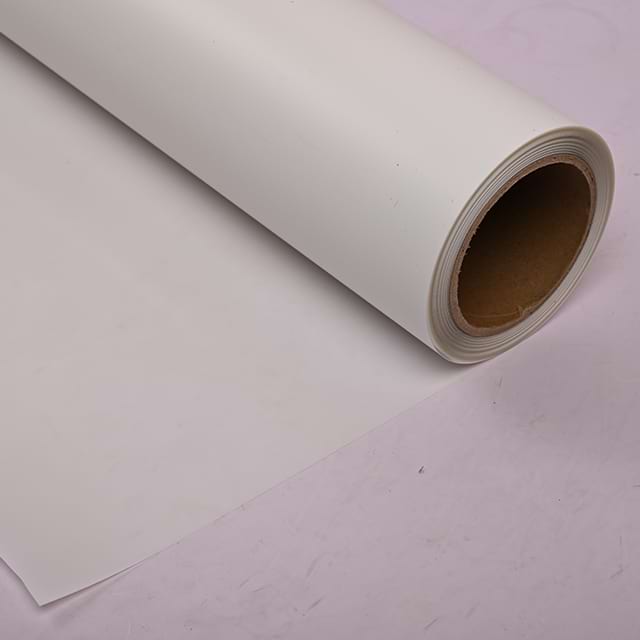
Premium backlit media is a composite material engineered for specific performance characteristics. The foundation is a rigid, high-stability 100% polyester (PET) base layer. This core provides the necessary tensile strength and dimensional stability to prevent sagging when installed in tension frames. Applied to this base is the engineered topcoat, which is responsible for ink reception, dot gain control, and light diffusion. The synergy between the inert PET base and the active topcoat defines the overall quality of the film. If the PET base is too thin, the graphic will warp under the heat of the printer lamps. If the topcoat is poorly formulated, the ink will simply sit on the surface and smear.
The architecture of the topcoat determines how ink is absorbed and cured. Micro-porous coatings feature a network of microscopic voids that draw ink into the layer through rapid capillary action. This immediate absorption freezes the ink droplet in place, preventing coalescence and mottling. It is the superior technology for high-speed, high-density printing. The capillary action works almost instantly, pulling the liquid carrier away from the pigment.
Swellable coatings operate differently. They consist of polymers that expand to encapsulate the ink upon contact. While they can produce excellent color gamut, the absorption process is significantly slower. This delay makes swellable coatings more prone to mottling in heavy ink-load scenarios, as the wet ink sits on the surface longer, increasing the risk of pooling or back-trap mottle before the coating can fully encapsulate the liquid. Swellable coatings are generally better suited for fine art reproduction where speed is not a factor, rather than high-volume commercial backlit production.
Manufacturers must achieve exact coating thickness across the entire web during production. Variations in coating weight lead directly to variations in ink absorption. If one section of the roll has a thinner coating, it will reach saturation faster, causing localized mottling. Edge-to-edge consistency is a strict requirement for large-format light boxes, where a single graphic may span several meters. Advanced manufacturing utilizes precision slot-die or curtain coating methods to ensure the micro-porous layer is applied with microscopic accuracy. Meyer bar coating, an older method, often leaves microscopic striations that become visible as banding once the graphic is backlit.
Print service providers must scrutinize technical data sheets (TDS) to verify uniformity claims before purchasing. Key metrics include opacity and whiteness, which indicate the baseline light transmission properties. Coating weight tolerance and base film thickness provide insight into the manufacturing precision. A tight tolerance in coating weight is a strong indicator that the matte backlit film will perform consistently from roll to roll, reducing the risk of unexpected mottling during a critical production run. Operators should look for a PET base thickness of at least 7 to 9 mils for large format applications to ensure structural integrity.
Backlit films are categorized primarily by their intended ink compatibility. Formulations exist for Eco-Solvent, Latex, UV, and Aqueous ink systems. Each ink chemistry requires a specific coating architecture to function correctly. Applying an ink to an incompatible coating will result in catastrophic print failure, ranging from complete lack of adhesion to severe mottling and ink migration. You cannot force a latex ink to cure properly on a film designed exclusively for aqueous dye inks.
Some applications favor aqueous-coated backlit films due to their ability to produce ultra-sharp line definition and facilitate rapid absorption. Aqueous inks, primarily water-based, interact seamlessly with specialized micro-porous coatings designed to wick away moisture instantly. This makes them popular for indoor point-of-purchase displays where viewing distances are very short.
However, many industrial applications demand the durability of an eco solvent matte PET film. These films require a highly specialized coating capable of withstanding aggressive solvent carriers without degrading the underlying PET base. The coating must balance the need for chemical resistance with the requirement for rapid ink absorption to prevent the solvent from pooling and causing coalescence. Eco-solvent prints offer superior scratch resistance and longevity, making them ideal for high-traffic areas like transit stations.
The interaction between aggressive eco-solvent carriers and the PET film's resin coating is complex. The coating must temporarily soften to accept the pigment and allow the solvent to flash off. If the coating swells excessively or breaks down, ink migration occurs, leading to blurred edges and mottled solids. The engineering challenge is creating a topcoat that reacts just enough to bond with the eco-solvent ink while maintaining its structural integrity to hold the dot shape perfectly. If the solvent bites too hard into the coating, it can actually warp the top layer, creating a textured, orange-peel effect that looks terrible when illuminated.
Proper evaporation of solvents is critical to preventing mottling. Printer heater settings—including pre-heaters, print-heaters, and post-heaters—must be calibrated to flash off the solvent carriers rapidly. This thermal management freezes the dot in place. If temperatures are too low, the ink remains wet, leading to coalescence. If temperatures are too high, the solvent boils, creating micro-blisters in the ink film that appear as a cloudy mottle under illumination. A standard starting point for eco-solvent backlit printing is 40°C for the pre-heater, 38°C for the print platen, and 50°C for the post-heater, though this requires fine-tuning based on the specific ink load.
The PET base must resist warping, curling, or tunneling under the high heat required for solvent evaporation. Physical distortion during printing alters the critical head-to-media gap. When the distance between the printhead and the substrate fluctuates, ink droplets land out of register or spread unevenly, causing localized density variations and mottling. A thermally stable PET core ensures a flat printing surface, which is essential for uniform ink laydown. Operators often use vacuum platens to hold the media flat, but if the PET base lacks thermal stability, the edges will still curl up and strike the printhead.
Mapping technical film features to specific visual outcomes helps operators select the right media for their clients. The physical properties of the film directly dictate the success of the illuminated display. You need to know exactly how the material will behave from the printer to the installation site.
Ink Density Capacity & Rich Solids: The coating must hold heavy ink loads to achieve rich, opaque blacks and brilliant color expression. Backlit applications often require double-strike or multi-layer printing. A high-capacity micro-porous coating prevents oversaturation and bleeding, ensuring solid areas remain dense and uniform without mottling.
Line Definition and Sharpness: A uniform micro-porous structure prevents ink feathering at high-density borders. This capillary control ensures crisp text and sharp graphics, which is vital for displays viewed at close range.
Light Diffusion Efficiency: The matte coating must scatter LED point-source light effectively. This diffusion eliminates harsh "hot spots" from individual LED bulbs while maintaining the overall image sharpness and contrast.
Scratch Resistance and Handling: The durability of both the unprinted and printed coating is evaluated during transport and installation. The media must withstand the physical stress of being loaded into tension fabric systems, snap frames, or theater backdrops without scuffing, which would otherwise show up as bright scratches when backlit.
Even premium films can exhibit mottling if operational realities are ignored. The interaction between the media, the ink, the printer, and the environment determines the final print quality. Operators must control these variables to extract the maximum performance from the substrate. Ignoring the print environment is the fastest way to ruin a roll of expensive backlit film.
Custom ICC profiles specific to the backlit film are mandatory. Generic profiles often lay down incorrect ink volumes, leading directly to coalescence. Operators must establish strict ink limits (total ink coverage) within the RIP software to prevent overwhelming the coating's absorption capacity. Finding the exact point of maximum density before saturation occurs is a standard calibration step.
Pass counts also play a significant role. Higher pass counts reduce banding and allow more time for the ink to dry between passes, significantly lowering the risk of mottling. The trade-off is decreased production speed. For high-end backlit graphics, sacrificing speed for higher pass counts is usually necessary to ensure flawless coating absorption. Running a backlit graphic on a 4-pass draft mode will almost guarantee mottling; operators should default to 12-pass or 16-pass modes for optimal density and drying.
Print-room conditions heavily influence ink behavior. Temperature and relative humidity affect static electricity generation and ink drying rates. Low humidity increases static, which can deflect ink droplets and cause a dusty, mottled appearance. High humidity slows down solvent evaporation, increasing the likelihood of coalescence. Maintaining a controlled environment ensures consistent interaction between the ink and the media.
Environmental Factor | Condition | Resulting Print Defect | Mitigation Strategy |
|---|---|---|---|
Humidity | Below 30% RH | Static deflection, dusty overspray, banding | Install commercial humidifiers; use anti-static bars |
Humidity | Above 60% RH | Slow drying, coalescence, ink pooling | Use dehumidifiers; increase post-heater temperatures |
Temperature | Below 18°C | Ink viscosity increases, poor flow, mottling | Maintain room temp at 22°C; allow media to acclimate |
Surface contamination alters the surface energy of the film. Fingerprints, dust, or machine oil repel ink, causing localized pooling and severe mottling. Operators must handle unprinted rolls with lint-free gloves and ensure the print environment is free of airborne particulates. Maintaining the native surface tension of the engineered coating is vital for uniform ink reception. Wiping the media with isopropyl alcohol is not recommended as it can strip the micro-porous coating and permanently damage the ink-receiving layer.
Download and install the specific ICC profile provided by the media manufacturer for your exact printer and ink set to prevent oversaturation.
Print a small test strip featuring a solid mid-tone gray and a dark blue gradient, then inspect it over a light table to verify coating uniformity before running the full job.
Adjust your RIP software to a minimum of 12 passes to allow adequate drying time between printhead sweeps, reducing the risk of back-trap mottle.
Calibrate your print-room environment to maintain 40-60% relative humidity and 20-25°C to stabilize ink viscosity and prevent static buildup.
A: Cloudiness is usually coalescence caused by the ink pooling on the surface rather than absorbing evenly. This often happens due to exceeding total ink limits in your RIP software, using mismatched media for your ink type, or insufficient heater settings that prevent proper drying.
A: You must print on the coated, matte side designed to absorb ink. The opposite side is the glossy PET base, which lacks an ink-receiving layer. Printing on the glossy side will repel the ink, causing severe smudging and complete print failure.
A: No. Cross-matching ink chemistries fails because aqueous coatings are not formulated to absorb aggressive solvent carriers. Using eco-solvent ink on an aqueous film leads to total print failure, extreme mottling, and potential damage to the coating structure.
A: Coating thickness requires a precise balance. It must be thick enough to hold dense ink loads for rich, vibrant colors, but remain translucent enough to allow sufficient light passage. An overly thick coating creates a dim display, while a thin coating causes ink saturation and mottling.
A: To fix ink pooling, reduce total ink limits in your RIP software, increase the number of print passes to allow more drying time, raise the printer's heater temperatures slightly to speed up evaporation, and verify you are using the correct ICC profile.


