


Views: 0 Author: Site Editor Publish Time: 2026-10-22 Origin: Site


Are head strikes ruining your garment prints? The dreaded scraping sound of a printhead dragging across warped plastic is a nightmare for any operator. Often, the root cause is not your ink profile or curing oven settings. It is simply utilizing the wrong film thickness for your specific hardware.
While premium inks and adhesive powders command much of the industry's attention, the foundational substrate dictates the success of every job. The physical properties of your DTF PET Film govern everything from feeding stability to moisture absorption. A mismatch here guarantees curling. Feeding jams follow. Eventually, you waste expensive apparel blanks.
In this comprehensive technical guide, we will break down the precise differences between the industry standard micron thicknesses. By understanding how these substrates interact with your equipment, you will learn how to choose the exact right film roll to eliminate mechanical headaches and streamline your production.
Thickness Dictates Stability: Micron thickness directly impacts printer feeding accuracy, heat tolerance during the curing phase, and overall ink absorption capacity.
The Industry Standards: 75-micron film serves as a highly cost-effective baseline for standard graphics. Meanwhile, 100-micron film provides superior structural rigidity for heavy ink loads and commercial-grade printers.
Error Prevention: Selecting the appropriate substrate mitigates common mechanical failures. These include edge curling, catastrophic printhead strikes, and roller slipping.
Hardware Compatibility: Modified desktop printers and industrial roll-to-roll machines operate under vastly different tension and friction parameters. They require specific film thicknesses for optimal output.
To make an informed purchasing decision, operators must first understand how film thickness is measured and why it fundamentally alters the physical printing process. In manufacturing, a micron represents one-millionth of a meter. When discussing transfer media, this measurement refers to the total thickness of the base substrate combined with its applied chemical coatings.
The film serves as a temporary, dimensionally stable carrier for your digital design. However, a transfer roll is not merely a piece of raw extruded plastic. It is an engineered matrix comprising multiple functional layers. At its core sits a Polyethylene Terephthalate base. On top of this core, manufacturers apply a specialized release coating for effortless peeling. This is followed by a porous hygroscopic ink-absorbing layer designed to hold wet pigment in place without bleeding.
Because different printing environments apply varying levels of extreme heat, heavy ink volumes, and mechanical tension, a universal approach simply does not work. The sheer mass of the base PET layer determines how much thermal expansion the material can withstand in the shaker oven. It also dictates how much liquid humectant it can absorb from the wet ink before warping out of shape.
Manufacturers produce substrates in several standardized specifications to accommodate a wide spectrum of hardware setups. Understanding the physical properties and limitations of these common thicknesses will help you align your consumable purchases with your actual production goals.
Currently, 75-micron film is the most widely utilized thickness across the entry-level and mid-tier market. It is highly regarded for its aggressive cost-to-performance ratio in standard daily printing scenarios.
From a practical standpoint, it is the most budget-friendly option. It significantly reduces the material cost per print. Its lighter weight makes it exceptionally easy to slice manually or process with standard automated cutters. Because there is less physical mass, it requires slightly less dwell time and heat to transfer the cured design onto the final garment.
Conversely, relying on a thinner structural core means it possesses a lower thermal mass. This makes the 75-micron material significantly more prone to edge curling when subjected to high curing temperatures. The same warping occurs when the film is heavily saturated with dense layers of wet white ink.
Positioned as the industrial upgrade, 100-micron film is engineered specifically for commercial reliability and heavy-duty applications.
This thicker medium offers exceptional dimensional stability. The added rigidity actively resists the dreaded U-shape curling inside the powder shaker. It easily handles massive white ink loads without buckling. It also provides a thicker tactile surface area for printer pinch rollers to grip, which virtually eliminates tracking errors.
On the downside, it carries a higher initial upfront cost per roll. Operators utilizing automated inline cutting systems may also need to manually increase their blade pressure settings. This ensures a clean snag-free slice through the denser PET core.
While the 75-micron and 100-micron specifications dominate the global market, specialized variations exist. Films measuring 80-micron or 90-micron are occasionally marketed as middle-ground solutions. They attempt to balance the low cost of the standard baseline with a slight boost in thermal stability. On the extreme end, 120-micron films are highly specialized. They are typically reserved for massive industrial web-press machines demanding extreme tension control. For standard apparel decoration, anything above 100-micron is generally unnecessary.
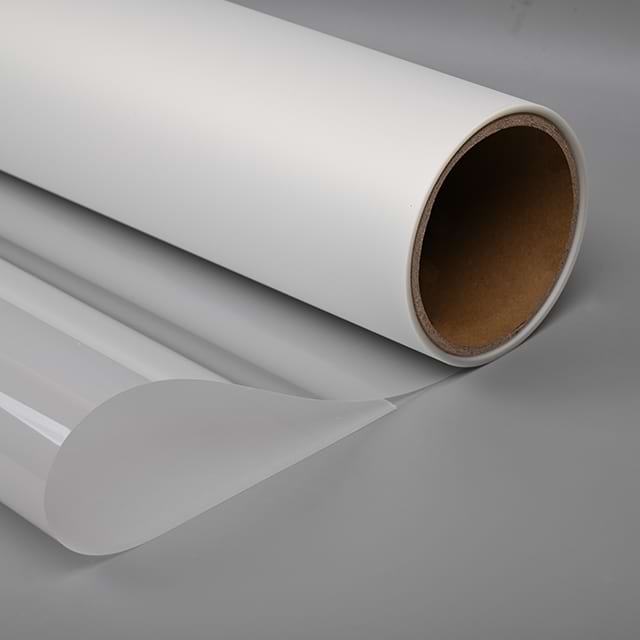
The thickness of your chosen roll directly influences both the mechanical handling and chemical phases of Direct-to-Film Transfer Printing. Failing to match the micron rating to your specific hardware capabilities can trigger a cascade of frustrating failures during a production run.
Printers rely on a synchronized series of pinch rollers and grit rollers. These pull the substrate through the print zone at microscopic intervals. Thin films can occasionally slip. This is especially true in modified desktop units where roller pressure may be uneven, degraded, or coated in paper dust. When the media slips even a fraction of a millimeter, horizontal banding or misaligned color registration ruins the final image. Thicker 100-micron films offer superior rigidity and a larger physical profile. This creates enhanced friction, allowing the rollers to maintain a consistent unyielding grip.
Modern transfer printing requires a highly dense underbase of white ink to ensure brilliant color opacity on dark cotton or polyester garments. This white ink contains a massive volume of liquid carriers, including water and heavy humectants. Depositing heavy wet ink onto a thin 75-micron surface compromises the surface tension. The sudden influx of moisture causes the film to buckle, creating valleys where the wet ink disastrously pools together.
If the material buckles upward while moving rapidly under the carriage, it triggers a printhead strike. This smears the design and can permanently scratch the delicate nozzle plate. A 100-micron substrate possesses the structural integrity required to hold these heavy liquid loads while remaining completely flat across the platen.
After the wet print exits the printer, it passes through an automated powder shaker and a high-temperature infrared curing oven. Heat naturally causes thermoplastic materials like PET to expand and warp. Thinner materials inherently have lower thermal resistance. If the oven temperature fluctuates or is set too aggressively to accommodate fast print speeds, the outer edges of a 75-micron roll will curl upward.
This curling can cause the film to scrape against the top heating elements of the curing tunnel. The result is smeared adhesive powder or a complete roll jam inside the machine. The denser mass of a 100-micron roll dissipates infrared heat much more evenly. It keeps the carrier flat and highly stable throughout the entire curing phase.
To determine the superior option for your specific business model, it is helpful to evaluate both substrates across standardized production metrics.
Feature / Metric | 75 Micron DTF Film | 100 Micron DTF Film |
|---|---|---|
Primary Use Case | Standard graphics, light-to-medium ink loads | High-density graphics, heavy white ink layers |
Cost Efficiency | High (Lower material cost per roll) | Moderate (Higher upfront investment) |
Dimensional Stability | Moderate (May curl under aggressive heat) | Excellent (Remains perfectly flat in high heat) |
Printhead Strike Risk | Higher (Prone to buckling with wet ink) | Very Low (Rigid structure prevents warping) |
Roller Grip / Tracking | Adequate (Can slip in older, dusty machines) | Superior (Excellent friction and feeding accuracy) |
Hardware Suitability | Desktop conversions, low-speed setups | Industrial roll-to-roll, multi-head printers |
The concept of better is entirely objective and tied to your operational reality. Commercial shops using high-speed dual-head printers output massive amounts of ink. For them, 100-micron is unequivocally better. The drastic reduction in misprints and head strikes easily offsets the higher raw material cost. Alternatively, smaller setups with strictly controlled ink limits and precise temperature regulation will find 75-micron to be a highly efficient and profitable choice.
Analyzing recent market data and equipment evolution reveals a distinct shift in how print shops approach consumable purchasing. Over the past two years, the apparel decoration industry has rapidly transitioned from modified desktop units to commercial-grade multi-head machines. These advanced setups typically utilize high-speed printheads capable of laying down incredibly thick wet layers of white ink in a fraction of the time older printers took.
To keep up with this rapid ink deposition, operators are forced to run their curing ovens at significantly higher temperatures. This ensures the adhesive powder melts fully before the film exits the tunnel. The combination of heavy wet ink and intense ambient heat acts as the natural enemy of thin PET media.
Consequently, field engineers and production managers note a massive migration toward 100-micron and double-sided matte substrates. Shops have realized that the hidden costs of using thinner media far outweigh the nominal savings of buying a cheaper roll. Printer downtime, ruined apparel blanks, and the catastrophic expense of replacing a damaged printhead due to a strike destroy profit margins. In today's competitive landscape, operational reliability and uninterrupted workflow dictate profitability. This reality establishes thicker more stable films as the new commercial standard.
Selecting the optimal micron rating for your production line is a technical decision. It is dictated by the mechanics of your printing equipment, your daily ink volume, and the physical environment of your workspace. Here is a practical breakdown to guide your selection.
Desktop printers are engineered with lighter feed mechanisms and smaller pinch rollers originally designed for standard photo paper. Because of this, a 75-micron roll is often the most compatible choice. The lighter weight and higher flexibility allow the relatively low-torque feed motors to advance the medium smoothly without straining internal gears.
Running thinner media on desktop machines requires strict discipline over your ink saturation limits. Desktop printers lack the advanced vacuum platens found in larger machines. Laying down excessive white ink will cause the 75-micron material to warp mid-print. If you must use heavy white ink on a desktop conversion, you can upgrade to 100-micron media. Just ensure your pinch rollers are meticulously cleaned with isopropyl alcohol to prevent the smooth heavier material from slipping.
The operational dynamics change entirely when moving to commercial wide-format systems. These industrial printers utilize heavy-duty tension bars and motorized take-up reels to advance the media at blistering speeds. For these robust environments, 100-micron thickness is practically mandatory.
The superior dimensional stability of the thicker base layer allows it to withstand aggressive mechanical pulling. It prevents the printed image from stretching under tension. More importantly, it possesses the thermal mass required to remain completely flat under elevated platen temperatures. This ensures the media maintains a precise safe distance from the fast-moving printheads.
Beyond printer mechanics, the ambient conditions of your production facility play a crucial role. Polyethylene terephthalate and its specialized coatings interact directly with the humidity of the surrounding air. In environments with high relative humidity, the hygroscopic ink-absorbing layer pulls moisture from the air. This causes thinner materials to become overly pliable. In these damp climates, upgrading to a 100-micron substrate provides a necessary structural buffer.
Conversely, in extremely dry environments, static electricity becomes the primary enemy. It causes the media to cling to the printer chassis. While both thicknesses can suffer from static, thicker 100-micron media often features more robust anti-static back-coatings. Its sheer physical weight also helps overcome minor static cling that would otherwise jam a lighter roll.
Diagnosing print failures often leads operators on a wild goose chase adjusting software profiles. Often, the root cause is a physical mismatch in media thickness. Recognizing these mechanical symptoms can save hours of frustrating troubleshooting.
The most destructive symptom of using a substrate that is too thin is edge curling. When moisture from heavy wet ink interacts with the coating, the material expands. If the base lacks the thickness to resist this expansion, the edges curl upward directly into the travel path of the printhead carriage. If you hear that terrible scraping sound or see smeared ink on solid block graphics, upgrading to a 100-micron roll is the most immediate mechanically sound solution.
Tracking errors, banding, and constant paper jam alerts are clear indicators of a feeding issue. If your printer's pinch rollers fail to maintain consistent friction against the back of the media, the printhead passes will not align perfectly. This happens when a 100-micron roll is too heavy for a weak desktop motor. It also occurs when a 75-micron roll stretches and slips under the immense pulling force of an industrial take-up reel.
Before the design even reaches the powder shaker, it must travel across the warm printer platen. If you observe the material buckling, rippling, or forming tiny puddles where wet ink pools together, the media is failing to support your ink load. Thin media simply lacks the absorption capacity and rigidity to hold high volumes of liquid pigment. Switching to a thicker substrate instantly provides a stable rigid platform that holds the ink flat.
Once you have determined the correct micron rating for your specific hardware, the next critical step is sourcing the material from a reputable manufacturer. Not all substrates are engineered equally. A poorly manufactured 100-micron roll with inconsistent chemical coatings will perform drastically worse than a premium 75-micron roll.
When evaluating suppliers, look beyond the simple micron rating. High-quality media should feature a multi-layer coating system. This includes a dedicated ink-absorbing layer that prevents bleeding and a specialized release coating for residue-free peeling. Professional-grade media incorporates anti-static treatments on the non-printable side. This prevents stray powder from clinging to empty spaces and ensures flawless feeding through the printer rollers.
For commercial operators and serious hobbyists seeking consistent empirical results, sourcing materials from specialized manufacturers is highly recommended. You can explore technical specifications and acquire premium DTF film rolls engineered for strict dimensional stability directly from Filmstarlight. By selecting a supplier that guarantees their thickness tolerances, you ensure that your production line remains predictable, profitable, and free of unnecessary downtime.
Choosing the right substrate thickness is a delicate balancing act between raw material costs and operational stability. 75-micron media offers excellent cost-efficiency for lighter ink loads and desktop setups. However, it can quickly become a liability in high-speed high-heat commercial environments.
Thicker 100-micron materials act as an insurance policy for your production line. By resisting thermal warping and supporting massive wet ink loads without buckling, they actively prevent costly printhead strikes. This eliminates the frustration of wasted garments. Operators must carefully evaluate their printer mechanics, daily ink volume, and ambient room conditions before making a bulk purchase.
If you are currently battling curling edges, mysterious banding, or pooling ink with your standard media, do not immediately blame your printer. Test a thicker option. Upgrading to high-quality DTF transfer film can instantly resolve mechanical headaches. Evaluate your current setup, explore the professional-grade options available at Filmstarlight, and protect your expensive hardware from catastrophic damage while optimizing your daily workflow.
No, the thickness of the carrier medium does not impact the final texture of the garment. The film acts strictly as a temporary carrier for the graphic during the printing and curing phases. The final feel, or hand, of the transferred design is determined entirely by the flexibility of the cured ink, the specific type of polyurethane adhesive powder utilized, and the pressure applied during the final heat press process.
Yes, it is mechanically possible, but it requires diligent maintenance. You must ensure your printer's pinch rollers are clean, free of slippery paper dust, and adjusted to apply adequate pressure. Some older or heavily used desktop printers may lack the motor torque to feed heavier materials consistently. This can lead to slipping and banding. However, machines in excellent condition typically handle 100-micron media effectively.
This is a classic mechanical failure indicating that the substrate is too thin for your current printing parameters. Curling occurs when a thin material is subjected to a heavy wet white ink load or excessively high platen temperatures. The moisture and heat cause the coating to expand rapidly, forcing the edges upward. Switching to a structurally rigid 100-micron substrate usually resolves this issue immediately.
Not necessarily. The term double-sided refers to a specific matte anti-slip coating applied to the back non-printable side of the media. This coating helps printer rollers grip the material more effectively and drastically reduces static electricity buildup. Both single-sided and double-sided variations are manufactured in standard 75-micron and heavy-duty 100-micron thicknesses. The choice between single or double-sided depends on your printer's feeding mechanism and your environment, not the required material thickness.
Yes, slightly. Thicker 100-micron films possess a higher thermal mass. This means they take slightly longer to heat up inside the curing oven compared to thinner 75-micron films. You may need to slightly decrease your belt speed or incrementally raise the tunnel temperature to ensure the adhesive powder melts completely evenly across the thicker substrate.
The most accurate way to measure film thickness in the field is by using a digital micrometer or a precision thickness gauge. Calipers can sometimes be used, but they may compress the soft chemical coatings, giving an inaccurate reading. If you lack these tools, check the manufacturer's spec sheet or packaging, as visual inspection between 75-micron and 100-micron is extremely difficult for the naked eye.


